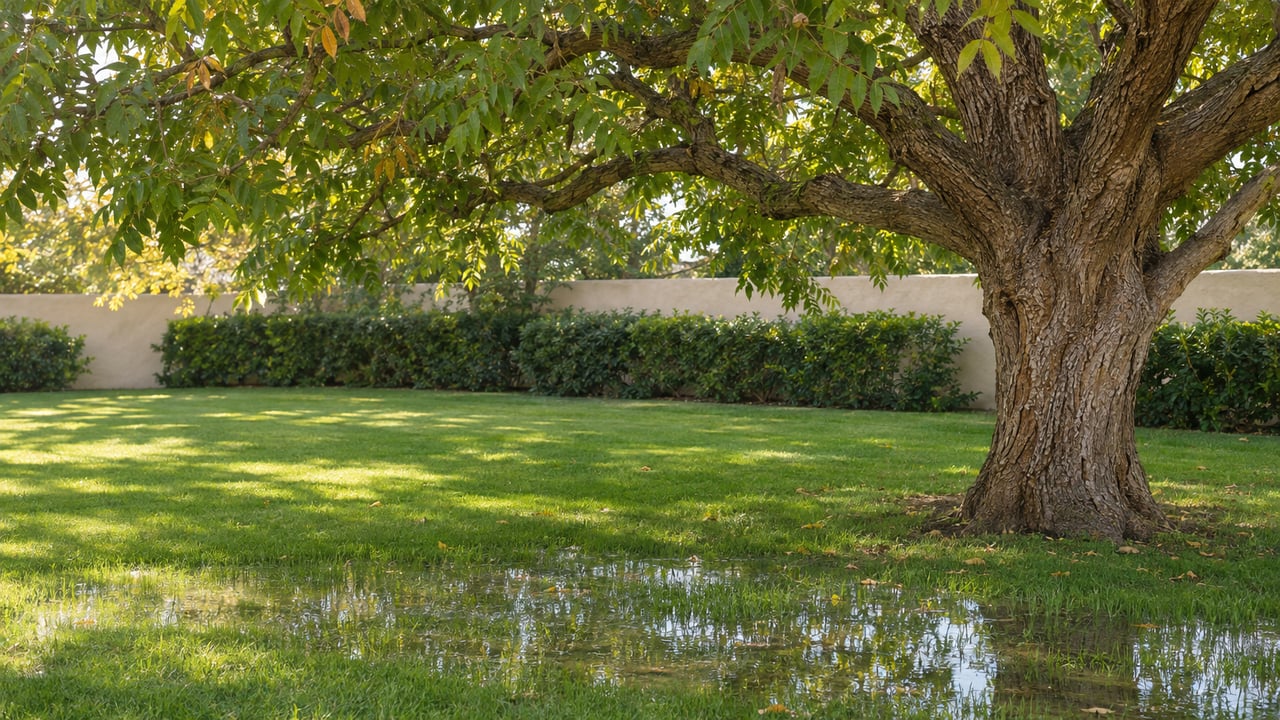
North Central's Flood Irrigation Winter Is Decided Before the Canals Go Quiet
November 12, 2026
November 12, 2026
"We only deliver water once a month during the cooler months and twice a month during the hotter months," Elvy Barton, SRP's senior manager of water and forest sustainability, told KJZZ in April. Each delivery lets "2 to 3 inches" of water soak over the land and seep in slowly. Barton said that builds the larger, deeper root systems found in older irrigated parts of town.
On flood-irrigated lots across North Central Phoenix, the winter calendar is short and comes early. A bill is due in December, monthly deliveries continue through the holidays, and on Jan. 3 the Northside canals go into maintenance. Most of what a homeowner controls this season has to happen before then.
SRP dries up parts of its major canals every fall and winter for construction, cleanup and repairs. The work is split by which side of the Salt River a canal sits on. This season's schedule:
North Central is north of the river, so its dates are the January ones. The Southside work that starts Nov. 20 doesn't apply here. During a dry-up, crews relocate fish, inspect the canals, remove debris and repair canal linings, according to SRP's Fall 2026 residential newsletter.
The yard feels that work directly. SRP's flood irrigation FAQ says deliveries come about every 28 days from October through March, "except during the annual canal maintenance period when no deliveries are scheduled." The effect isn't the same everywhere. For last winter's Northside dry-up, SRP said household water service would not be affected, but some Northside irrigation customers would not receive canal water. Each irrigating neighborhood has its own list of delivery days, order deadlines and schedule release dates. You can find yours in SRP My Account or by calling SRP at (602) 236-3333.
On a 28-day cycle, a lot whose last delivery falls in late December could go well over a month before the next one arrives in February.
The first 2027 irrigation deadline is a payment. SRP's newsletter tells customers that 2027 irrigation bills are on the way and to pay by Dec. 6. Starting Jan. 7, a late fee of 1% per month applies to any unpaid balance.
SRP's summary of 2027 residential water charges shows every main rate up slightly from 2026:
| Charge | Calendar year 2026 | Calendar year 2027 |
|---|---|---|
| Water delivery fee, per active account | $93.87 | $97.34 |
| Delivery fee add-on, per acre | $0.45 | $0.47 |
| Basic charge, 1st and 2nd acre-foot, per acre | $53.52 | $56.16 |
| Additional stored and developed water, 3rd acre-foot | $18.45 | $19.00 |
| Supplemental supply, 4th to 7th acre-foot | $63.77 | $66.92 |
For a typical lot, the total due is the more useful number. The 2027 schedule lists $166.00 for a 0.20-acre lot, $303.33 for 0.60 acres and $440.65 for a full acre. Customers can pay in two installments instead. The first is due Dec. 6, 2026, and the second is due June 6, 2027. On a 0.20-acre lot, that's $83.00 each time.
The flat per-account fee is the part of the bill that doesn't shrink with the lot. On a 0.20-acre lot, the 2027 delivery fee of $97.43 is nearly 59% of the $166.00 total. On a full acre, $97.81 is about 22% of $440.65. Most of a small lot's bill pays for access to the system. Most of a large lot's bill pays for water.
The service fees stayed the same for 2027. A new account is $25.90, a name change is $8.10 per deed, and reactivating an account is $7.00. The name-change fee is the one that comes up when an irrigated property changes hands.
Winter lawns put the most strain on the schedule. The University of Arizona Cooperative Extension's turfgrass maintenance guide gives Oct. 10 to Nov. 10 as the window for seeding winter grass in Phoenix. That window closed on Nov. 10.
Watering needs differ a lot depending on whether a lawn was overseeded:
Compare those intervals with flood water arriving about once every 28 days, plus a January stretch with no scheduled deliveries at all. The AZMET guidance is a lawn-care interval, not a flood delivery schedule, so for an overseeded yard most of the watering between floods has to come from somewhere else. A dormant Bermuda lawn fits the monthly rhythm much more easily.
SRP's fall newsletter gives most of its attention to trees. It calls fall a good time to plant shade trees such as mesquite, desert willow and palo verde, plus fruit trees including citrus. It says deep flood irrigation helps roots grow farther into the soil and makes plants more drought-resilient over time.
North Central has older examples of that idea. A KJZZ photo with the April story shows a stand of nearly 100-year-old eucalyptus trees along the canal bank near Northern Avenue. The North Central Phoenix Homeowners Association made the same link when it announced an Oct. 29 Water & Heat Symposium. The program covered Phoenix's water supply, SRP and the advantages of living in a flood irrigation district. The association described water as central to:
"protecting North Central's treasured urban canopy."
A tree planted this fall would get its remaining November and December deliveries before the Northside pause begins.
SRP's responsibility ends at a specific point. Barton told KJZZ that SRP delivers to "the high corner of a neighborhood," and from there the neighborhood manages and maintains its private flood irrigation system. Some of those systems run through pipes and some through open ditches.
That's why SRP's maintenance advice is aimed at homeowners. In a September irrigation Q&A on the SRP blog, the utility says open ditches should be cleaned every other month in winter and every other week in summer. Built-up grass and roots push back against the water and can affect delivery. Where an open ditch flows into a pipe, the pipe can clog, and SRP says anything broken or cracked should be fixed right away.
A cleanup on that every-other-month schedule fits naturally in the weeks before Jan. 3.
The same Q&A covers travel. SRP says to order only when you need water and to cancel any recurring orders if you'll be out of town. Otherwise, someone like a neighbor or family member needs to handle the water scheduled for your property. The FAQ adds that orders should be changed or canceled before the deadline, because late changes or cancellations can cause flooding.
Order size is the other choice to make. Water can be ordered in five-minute increments up to your property's maximum allocation, which depends on acreage and water rights. SRP suggests starting with the length of time most often ordered in the past, or asking neighbors with similar yard sizes and plantings. With the Northside pause starting right after New Year's, the late-December order is the last one before the gap. Its deadline is listed in SRP My Account with the rest of your neighborhood's dates.
Rates and fees in this post come from SRP's published 2027 schedule, which notes that charges are subject to annual board approval. It's general information, so check your own account and bill directly with SRP.
If an irrigated North Central lot is part of your plans for spring, you'll want the ditch, the delivery history and the SRP account in order before buyers start asking about them. Whether that means getting the yard ready to show or making sure the water account moves with the deed, Josh Gonzalez can help you work through the details. Let's Connect.
Stay up to date on the latest real estate trends.


Find Your Dream Home
Whether you’re buying, selling, or simply exploring your options, I’m here to listen, strategize, and deliver. Let’s connect to discuss your goals and see how my approach can help you move forward with clarity and confidence.