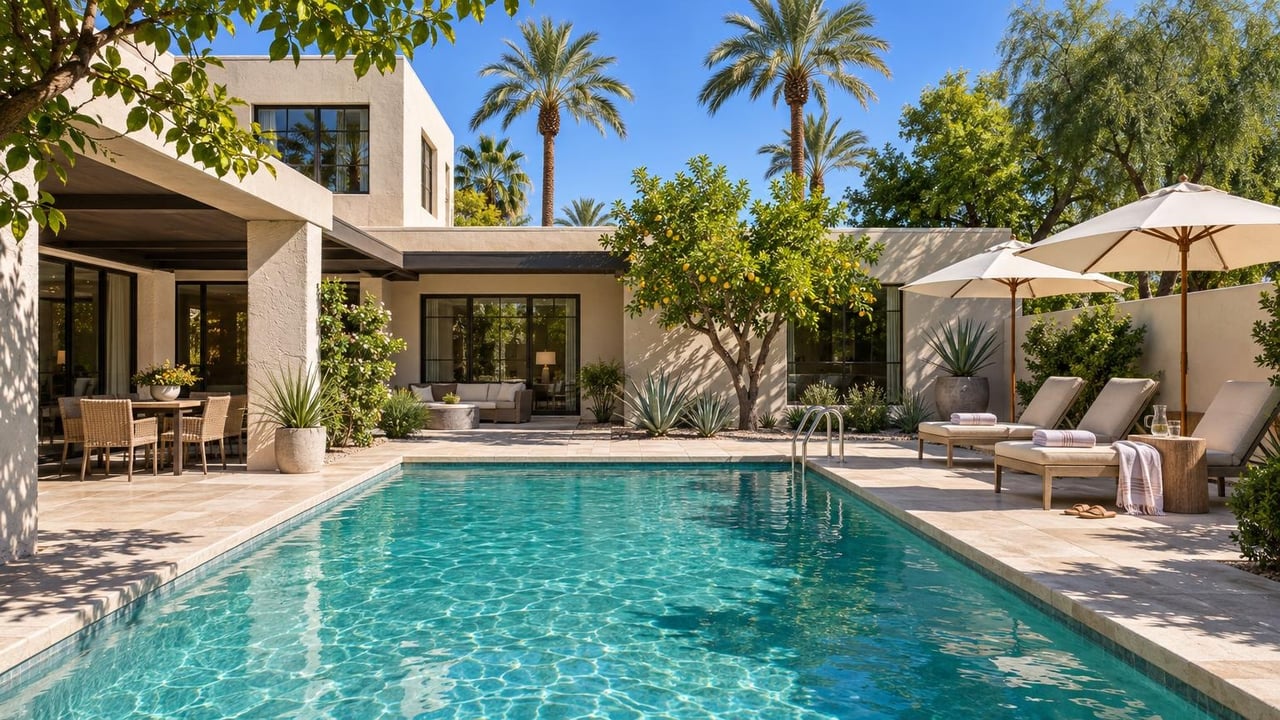
How to Tell the Enclaves of Arizona Biltmore Estates Apart
November 26, 2026
In February 1976, Arizona Biltmore Estates, Inc. sold its first development parcel. Parcel 34 went to Davis Development, which built an apartment complex called the Cloisters. The covenants that still shape the Biltmore were written and recorded as part of that sale. Today the Cloisters' own association describes it as a condominium community next to the resort, north of Camelback Road and 24th Street. It has its own gate, its own pool and a Tea House whose patio overlooks a pond. Those amenities belong to the Cloisters and to no other community in the Estates.
The rest of Arizona Biltmore Estates grew the same way, one parcel at a time. Buyers searching inside the gates often treat the Estates as one neighborhood with one amenity package. From that first sale on, each community's developer was expected to supply its own gate, pool and courts, so the enclave decides what daily life includes before the floor plan does.
The Estates as it exists now goes back to June 1973. That month Talley Industries, a Mesa-based manufacturer, bought Arizona Biltmore Estates, Inc. from the Wrigley-Offield Trust. The purchase included the Arizona Biltmore Hotel, the Wrigley Mansion, the Adobe Golf Course and roughly 900 acres of undeveloped land. Talley planned to sell off the land quickly and use the proceeds to remodel the hotel and the course. Ten days after the purchase, the hotel caught fire.
After the rebuild, the company hired the Frank Lloyd Wright Foundation and PRC Toups Engineering to prepare an engineering, zoning and development plan, which was filed with the City of Phoenix in April 1974. It divided the property into 43 parcels for planning, marketing and development. An October 2020 newsletter from the Arizona Biltmore Estates Village Association credits Vernon Swaback and the Foundation with that 1974 master plan.
Most of what a buyer sees on a tour today follows from how the parcels were sold. When the covenants were recorded with the Parcel 34 sale in 1976, the association's own history says, the company never intended to build common recreational facilities beyond roads and entrances. Security gates, tennis courts and swimming pools were left to the developers of the individual communities, and keeping them up became the job of each community's association. In 1978 the hotel was sold to Rostland Arizona, and by 1983 the hotel owner's voting rights had passed to the master association. The parcel-by-parcel structure stayed in place.
The Arizona Biltmore Estates Village Association, or ABEVA, is the master association for residential properties and certain commercial properties in the Biltmore area. It counts 17 residential communities, each with its own sub-association, and most of them are run by professional management firms.
ABEVA maintains landscaping, streetlights and paving in the common areas outside the individual communities. One exception is Thunderbird Trail from 24th Street to the hotel entrance, which the hotel maintains. ABEVA also runs a roving patrol around the clock that covers every area, including the individual communities. Its Architectural Committee controls architecture and landscaping outside the communities. ABEVA's overview reports 1,688 homeowners and says the annual assessment is paid in advance on November 1, the start of its fiscal year.
For budgeting, ABEVA's October 2020 newsletter put the point directly: owners make at least two HOA assessment payments, one to the master association and one to their own community. The master assessment pays for the streetscape and the patrol. The community assessment pays for the gate, the pool and whatever else that enclave's developer built, so the second payment is set community by community. We covered this in an earlier post on the reserve fund question Biltmore condo buyers face. The amount and health of each assessment are worth reviewing in each community's documents. This post is general information, not legal or financial advice, so confirm the figures for any specific home with the association and your own advisors.
ABEVA's directory of sub-associations shows how the 1974 parcels turned into separate communities. The list includes 2 Biltmore, Courts I, Courts II and Vistas, Villas II, Fairway Lodge, Gates, Biltmore Greens, Shores, Square, Terrace, Cloisters, Colony Biltmore and CB Greens, Del Prado, Heights at Biltmore, Meridian, Taliverde and Village on the Lakes, each paired with its management company.
The Cloisters. Its association describes a gated condominium community with a courtesy guard, greenbelts, a central pool and the Tea House overlooking a pond. The Cloisters began as the first parcel ever sold in the Estates and was built as apartments. It is now a condominium community, and its grounds center on one shared pool and garden.
Colony Biltmore Greens. The community's design guidelines, dated June 2022, describe a guarded entry and two tennis-court common areas, one on the east side and one on the west. A buyer who plays tennis would find courts inside this community's own gate, paid for through its own assessment.
Biltmore Terrace. As 2024 came to a close, Biltmore Terrace's HOA reported a year of upgrades. It improved both of its pools, building walkways, community bathrooms, and the flooring and equipment in its fitness center, and it added a common-area lighting plan. It also installed a security-card system, round-the-clock cameras in the common areas and a new gate. That is a community investing in its own amenities, as the arrangement set down in 1976 expected each community to do.
All three answer to the same master association. The Cloisters has a courtesy guard and a Tea House, Colony Biltmore Greens keeps tennis courts on two sides of its grounds, and Biltmore Terrace pairs two pools and a fitness center with a card-access system. That variety dates back to the 1970s.
Some of the most prominent homes in the area sit outside ABEVA entirely. The master association's overview says certain "grandfathered" properties on Biltmore Estates Drive are exempt from its control. ABEVA's October 2020 newsletter counted 33 grandfathered residences on Thunderbird Trail and Biltmore Estates Drive. They are not members, and they are exempt from the ABEVA covenants.
Biltmore Estates Drive is also where the area's price records have been set. KTAR republished Phoenix Business Journal reporting that a 14,554-square-foot home at 40 Biltmore Estates Drive closed for $9.5 million in cash on September 4, 2025. That was the highest-priced home sale in the community's history. The previous record was $7.9 million in cash for a 17,819-square-foot home next door, which sold in December 2024. Between them, those two sales show the top of the Biltmore market over roughly nine months. They also show that a Biltmore address can sit inside or outside a given association, and for a home on this street, the documents are what tell you which.
The ABEVA newsletter also tells the story of the Grand Paseo, the walkway many neighbors call the pink sidewalk. The idea goes back to the Wrigleys in the 1930s. Under Arizona Biltmore manager Harry Boyle, pink paths were laid so hotel guests could walk the grounds and head north toward the foothills of Squaw Peak, around the resort's reservoir. The 1974 master plan revived it as a combined equestrian, pedestrian and bicycle trail running between the Arizona Canal and Squaw Peak Park. Parts were built as homes went up north of Rose Lane. Hotel construction, revised subdivision layouts and golf course use interrupted most of the planned route, and the City of Phoenix never agreed to take over its maintenance. In the late 1980s, ABEVA made improvements so the trail could pass under Lincoln Drive.
On a walk, the Grand Paseo traces the 1974 plan. The parts that got built connect homes that went up under that vision, and the gaps show where individual parcels and the golf courses went their own way. Today the courses are the Links Course, a Bill Johnston design, and the Estates Course, which opened in November 2023 on the former Adobe Course site after a year-long rebuild led by designer Tom Lehman. The clubhouse between them has its own history, which we covered in our look inside the Arizona Biltmore Golf Club's clubhouse.
The Cromford Report's snapshot for November 22, 2026 put the Cromford Market Index for Greater Phoenix at 62.4, with a supply reading of 113.6 and a demand reading of 70.9. Those figures cover the whole metro, not the Biltmore. With the supply reading well above the demand reading across the metro, buyers in the Estates can take the time to compare enclaves before choosing a house.
When two Biltmore listings look similar on paper, these questions usually separate them:
In Arizona Biltmore Estates, the gate you drive through each evening, the pool you swim in and the courts you book all come from the enclave. Our Biltmore neighborhood guide covers the wider area around the resort.
If you are comparing homes inside the Estates and want help weighing what each enclave includes alongside the house itself, Josh Gonzalez can go through the listings with you one community at a time. If you already own in the Biltmore and are wondering how your enclave's amenities affect your home's value, start with a home valuation. Let's connect.
Stay up to date on the latest real estate trends.
Find Your Dream Home
Whether you’re buying, selling, or simply exploring your options, I’m here to listen, strategize, and deliver. Let’s connect to discuss your goals and see how my approach can help you move forward with clarity and confidence.